Some songs stay engraved in your memory, but some videos get in through your eyes and make you want to pack a suitcase on the spot. As Colombians, we grew up with music playing in the backyard, at the corner store, or on the neighborhood bus. But in recent years something beautiful happened: the whole world started noticing that our rhythms didn't just sound delicious: the country looked like an absolute paradise on screen. Our geography is so absurdly diverse that an artist can film a scene on a Martian landscape in the morning and, a couple of hours' drive later, be dancing by the Caribbean Sea at sunset. Who wouldn't swell with national pride seeing their homeland become the most sought-after film set on the continent?
Our landscapes stopped being mere decorative backdrops and became the true protagonists of the global music industry. Make yourself a good coffee (with a splash of milk if you're in chilly Bogotá, or iced if you're reading us from the coast) because today we're touring the spectacular corners that gave images to today's biggest musical hits.
The Tatacoa Desert: pure mysticism in Huila
Walking through the Cuzco sector of the Tatacoa Desert is the closest thing to stepping on Mars without leaving Colombia. The earth has a clay color so intense it looks hand-painted, carved into labyrinths and gullies sculpted by wind and rain over thousands of years. It's a silent, imposing place charged with an energy that gives you goosebumps.
This jewel of the Huila department was chosen by psychedelic rumba band Bomba Estéreo for their hit "Duele." The video, directed by Sam Upton, is a visual work of art that harnesses the Tatacoa's mystique to create a hypnotic atmosphere. The aerial shots of Li Saumet walking among the red canyons, combined with synthesizers and the flauta de millo, achieve a perfect connection between electronic vanguard and ancestral land. If you visit, here's a traveler's secret: stay overnight to see the night sky. With no light pollution, the stars look so close you could almost touch them.
San Andrés and Providencia: Systema Solar's raizal manifesto
If one band understands the language of the deep Caribbean (without pretensions or prefab-postcard luxuries), it's Systema Solar. While traditional tourism sells San Andrés for its all-inclusive hotels, this visual and musical collective dove into the heart of the archipelago to shoot the video for "Antena," a living tribute to raizal culture.
In this clip you won't see the usual generic shots. It was filmed showing the islands' everyday life: the "picós" (those gigantic hand-decorated sound systems), the dancing, the smiles of local kids, and life in neighborhoods that breathe to the rhythm of reggae and dancehall. The video is an explosion of color where the sea of seven colors meets African heritage and Creole. It's the ultimate proof that a location's beauty isn't only in its white-sand beaches, but in the dignity and joy of its people.
From Barranquilla to Santa Marta: the coastal route by bicycle
Few videos have done as much for national tourism as "La Bicicleta," the historic collaboration between Carlos Vives and Shakira. Though many assume it was shot in hidden nature reserves, the charm of this production is that it captured the most authentic urban and beach essence of the Colombian Caribbean — the one lived without Instagram filters.
The visual journey starts on the beaches of Puerto Colombia, with its old pier full of nostalgia, passes through the joyful chaos of Barranquilla (where Shakira visits her old school and melts into a hug with her people) and ends on the streets of Santa Marta. The scenes of both singers pedaling through traffic, greeting mototaxi drivers, and ending in a beach-soccer kickabout in the legendary Pescaíto neighborhood show the real Colombia. The one where life is lived outside, on the street, with heat, sweat, and a spontaneous smile. It's a journey proving that our coast's true magic isn't a private resort, but the flavor of its everyday life.
Medellín: the new aesthetic center of the urban genre
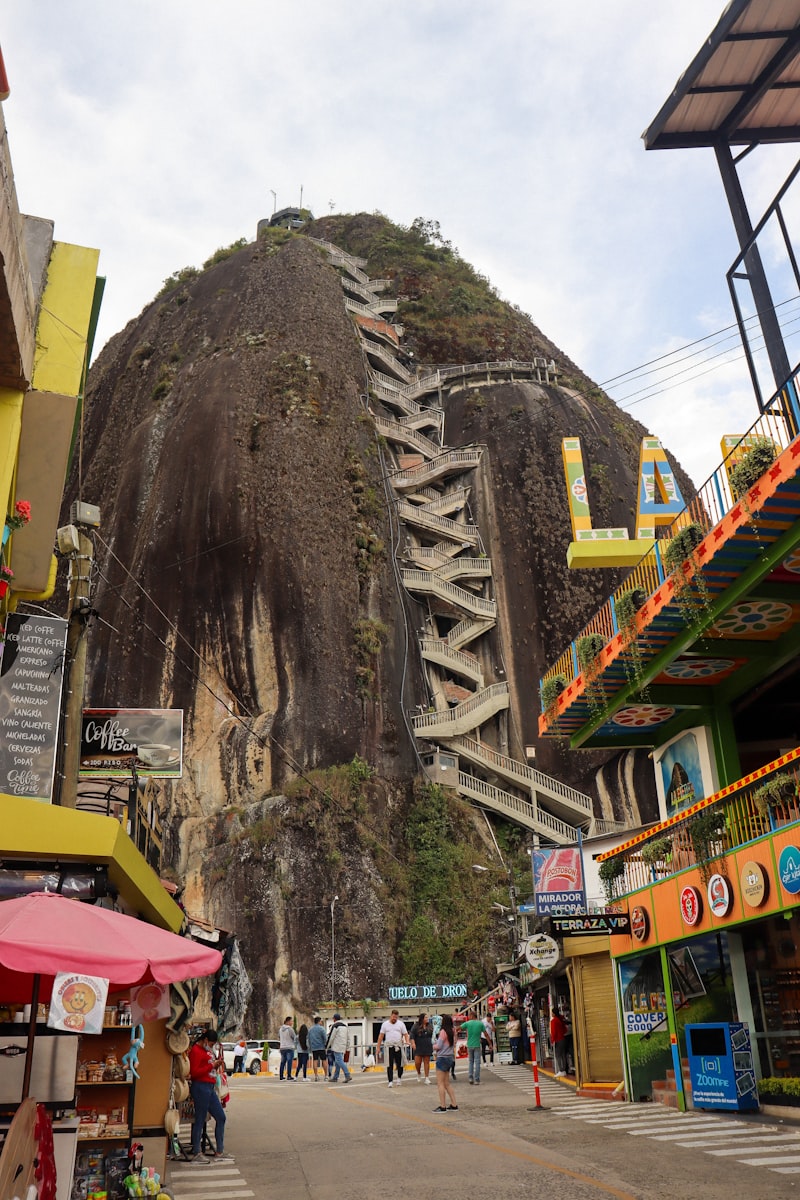
We can't talk about music videos without mentioning Antioquia. Although towns like Guatapé have won travelers' hearts with their colorful zócalos and the imposing Piedra del Peñol, reggaeton's true visual revolution took over the streets of Medellín. The Antioquian capital went from industrial city to the most sought-after film set on the continent.
A great example is "Qué Raro," the track with which Feid started making waves alongside J Balvin. The video stays home, in the neighborhood, with no need to chase rural landscapes. It shows the local barbershops, the corners where parceros gather to talk about life, the football pitches, and the city's street aesthetic. Shooting in Medellín gives videos a layer of truth and authenticity. Paisa pride shows in every frame: the architecture defying the mountains, the Metrocable in the background, and that culture of hard work that defines the region.
The magic behind the camera
Filming in our country has a component no Hollywood or Miami studio can buy with any budget: the warmth of the people. When a film crew arrives in a Colombian town, the community doesn't just watch; it gets involved, helps carry cables, offers tinto, and ends up appearing as extras in the shots.
| Main location | Artist / Song | What makes it unique |
|---|---|---|
| Tatacoa Desert | Bomba Estéreo (Duele) | Its red clay formations and mystical silence. |
| San Andrés Islands | Systema Solar (Antena) | The contrast between turquoise sea and picó culture. |
| Pescaíto and Puerto Colombia | Carlos Vives & Shakira (La Bicicleta) | Neighborhood life, street football, and Caribbean warmth. |
| Streets of Medellín | Feid & J Balvin (Qué Raro) | Urban aesthetics, neighborhood pride, and the paisa movement. |
At the end of the day, the most beautiful music videos filmed in our land are the ones that don't try to disguise it as something else. The ones that let the landscape speak for itself, let the Caribbean sun naturally overexpose the shot, or let the afternoon rain soak the pavement while people keep dancing in the street.
Which of these videos makes you want to pack your bags and tour the country? Which corner of your homeland is waiting for an artist to discover it and film the next world hit?