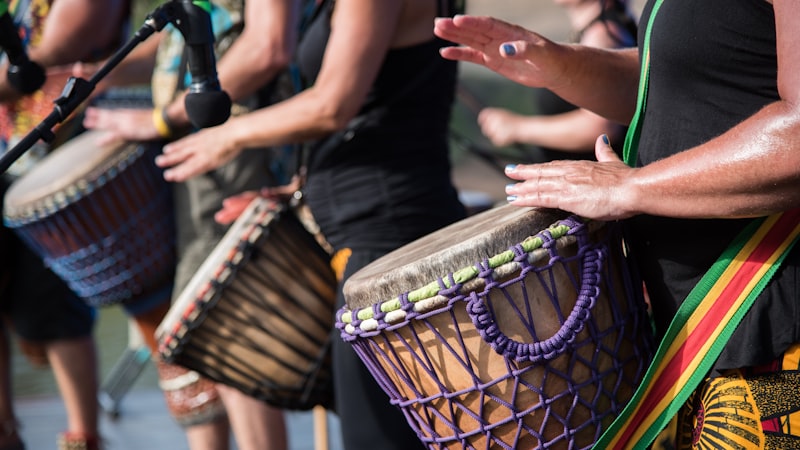
There are nights in the Colombian Caribbean when all it takes is the first dry strike of a tambor alegre — the lead drum of cumbia — to know the real party is about to ignite. A gaita flute cuts through the air with its high-pitched cry, the maracas begin to mark the path and, almost without noticing, your feet start moving on their own, searching for the dust of the earth.
That is no coincidence, and it is not just music. That is the pure power of cumbia.
Asking what cumbia is has nothing to do with dusting off a history book in some Bogotá library. For us Colombians, it means remembering grandma "tirando paso" (busting a move) in the living room, feeling that delicious rumble in your chest on the banks of the Magdalena River, and understanding the exact blend of bloodlines that defines us as a country.
More than a musical genre, cumbia is dance, gathering, and living memory. It is one of the most powerful cultural expressions of our Atlantic Coast and the result of centuries of shared knowledge among Indigenous peoples, African communities, and European traditions.
A meeting of cultures on the shores of the Caribbean
The exact origins of cumbia still keep more than one historian up at night. There are several theories about the towns and the precise processes that ended up shaping it across our coastal geography. What is crystal clear to those of us who grew up listening to it is that it emerged in the Colombian Caribbean, within a society marked by the crossing of three worlds.
That mestizo history was engraved in every instrument of the ensemble:
- The African heritage: it rumbles in the stretched drumheads and the force of the percussion. The tambor alegre, the llamador, and the tambora provide that deep heartbeat that makes your pulse race.
- The Indigenous imprint: it resounds sweetly in the gaitas and the caña de millo (a small cane flute), along with the steady shimmer of the maracas and the guache (a seed-filled rattle).
- The Spanish touch: you can see it in the elegance of the costumes, the long flowing skirts, the sung verses, and the flirtatious courtship.
Trying to break cumbia down into a mathematical recipe would strip away all its magic. Cumbia was not born overnight. It kept transforming across generations until it became the living tradition that fills us Colombians with pride today.
Gaitas and drums: the heart of the circle
A traditional cumbia circle — the "rueda" — does not need a giant orchestra to make the whole town square rumble.
The tambor alegre has full freedom to improvise and converse directly with the dancers. The llamador keeps a steady pattern like clockwork, while the tambora drops those delicious low notes you feel straight in your stomach. Over that foundation come the gaitas, handcrafted from a cactus stem with a head made of beeswax and charcoal. Their long, piercing sound is one of the most beautiful trademarks of our Caribbean.
There is no single instrumental lineup for the "parranda" (the party), either. There are traditional gaita ensembles, caña de millo groups, sabanero lineups with accordion, and tropical orchestras packed with brass. That ability to adapt to whatever is at hand is the main reason this rhythm has outlived every trend.
A courtship dance around the candles
Cumbia is lived and felt with the body. In its most traditional forms, the dance is an elegant game of flirtation, approach, and distance, where the man tries to win her over and the woman sets the tempo on the dance floor.
The candles are, without a doubt, the most iconic element of this ritual. Traditionally, it is the women who dance holding a bundle of lit candles. In colonial times, when there was no electric light in the plazas, the candles simply illuminated the open-air party. Over time they became part of the choreography — and a rather clever trick to keep a partner at bay if he got a little too forward.
Watching a costeña (a woman from the Coast) glide with ease while guarding the flame of her candles and making her pollera (the traditional wide skirt) float in the air is one of the most beautiful sights you will ever witness.
How cumbia is actually danced — without "dar papaya"
Here is a local tip ("dar papaya" is Colombian slang for leaving yourself wide open to embarrassment): cumbia is not danced with wild jumps or strange salsa spins.
The woman glides with an upright posture, taking short, subtle steps while her enormous skirt draws waves in the air. The man has more room to move around her — crouching, playing with his sombrero vueltiao (the iconic woven hat of the Caribbean coast), and making courtship gestures.
There is no single correct way to dance it, either. The moves change quite a bit depending on whether you are in El Banco, in Barranquilla, or in the savannas of Sucre and Córdoba. And although there is a popular myth that the man's steps mimic the dragging of chains from the era of slavery, many masters and keepers of the tradition prefer to explain it simply as a swaying walk, very close to the earth.
El Banco and the true cumbia heartlands
If there is one place on the map we hold in our hearts as the cradle of this rhythm, it is El Banco, in the department of Magdalena. Strategically located where our great rivers meet, this town became the great guardian of the tradition. Every year it hosts the Festival Nacional de la Cumbia José Barros, an event every Colombian — and every traveler — should experience at least once.
But the cumbia map does not stop there. The tradition is alive in communities across Bolívar, Atlántico, Sucre, Córdoba, and Cesar. Cities and towns like Barranquilla, Ciénaga, Plato, Guamal, and San Jacinto have each developed their own style of playing it, singing it, and enjoying it.
From Colombia to the whole continent
Cumbia pulled off a feat very few musical styles in the world ever achieve: crossing every imaginable border to become the soundtrack of an entire continent.
In the mid-20th century it traveled across Latin America on vinyl records and radio broadcasts. In Mexico it took deep root, giving rise to cumbia sonidera. In Peru it blended with electric guitars to create chicha. In Argentina it morphed into cumbia villera, and in countries like Chile, Ecuador, and Bolivia it is the can't-miss soundtrack of family parties.
Every country added its own seasoning, but the umbilical cord always leads back to the beaches, marshes, and rivers of Colombia.
Feeling the tambora on its home soil
You can stream a thousand songs on Spotify or watch every documentary out there, but nothing beats the experience of stepping into a live cumbia circle.
If you are planning a trip along the Coast, do not think twice: head to the Festival Nacional de la Cumbia or live it at the Carnaval de Barranquilla. Have a sip of rum, step up to the circle without shyness, and let the beat of the drum do the rest.
Have you ever dared to dance cumbia, or does stepping onto the dance floor still make you a little shy?